Vanessa Winship: Sweet Nothings

Updated: Sep 2
Every now and then I'm revisiting some of the photography books and other items on my shelves here. This time it’s . . .

If photography has taught me anything over the years it is that there is no such thing as a simple portrait, no matter how straightforward they may appear. How we read them will depend on who we are, who they are, where they were photographed, why they were photographed, who photographed them, and so on. It’s a complex relationship and it’s perhaps why I find portraits so fascinating.
Vanessa Winship’s Sweet Nothings, published as a book in 2008, portrays young schoolgirls in Turkey’s Eastern Anatolia region; a poor, rural borderland linking Iraq, Iran, Azerbaijan and Armenia. The title of the book refers to the short, sweet phrases embroidered on the their school uniforms along with the delicate patterns and flowers that decorate them. Look closely and you’ll see that no two uniforms are the same, not only in their embroidery but also in their cut and fit. They are handmade, sometimes a little too large to give an extra year of use as the girl grows into them. In these small differences the uniforms speak not only of community and tradition, but of the care and pride invested in the girls by their families. They are practical garments, but the flowers, patterns and embroidered words also celebrate young femininity in a place where childhood may be short and the demands of work and family arrive early.

The portraits themselves are seemingly simple (but are they ever?) — the girls stand in front of the camera, sometimes alone, sometimes paired with a friend or perhaps a sister. The distance and framing remain largely consistent. Backgrounds change but also repeat - a classroom, a courtyard, the edge of a field — just enough to give us context. There is little in the way of posing; rather, the girls simply present themselves to the camera in what Winship describes as their “…small moment of theatre…”.
As such, these images belong to an established tradition in documentary photography, dating back to August Sander and passing through Diane Arbus, John Myers, Shelby Lee Adams and many others along the way. As in Sander’s work, the frontal pose and minimal environment allow us to study the differences in posture, expression and dress that characterise each person. Sander was a master of this, revealing differences through the smallest details — how a boxer ties his shoes, how a farm worker wears his hat. Similarly, in Vanessa Winship’s portraits, there is enough space and quietness to allow us to dwell on each subject. It is a pleasure to look closely at these girls and imagine something of their character, their relationships, their sense of fun, seriousness, confidence, curiosity, anxiety and determination — qualities they will carry with them into adulthood.

The idea of a threshold is apparent. The girls stand close to the bottom of the frame while at the same time isolated in the space around them. They are poised but without any obvious sense of transition. They don't look as though they are about to leave in search of new lives or new horizons. They seem anchored — in their landscape, their families, their friendships and their community. Whatever social change may be happening in this part of the world, the very fact that these girls are attending school is perhaps already a sign of progress. Yet if the photographs are capturing a moment, it does not appear to be one that looks beyond the life these girls already know. At least that is my impression.
The large-format camera also plays a role in the way we read these images. It's a slow and fairly cumbersome process: the camera fixed on a tripod, a 5×4-inch sheet of film loaded between each exposure, the photographer disappearing beneath a cloth to focus the lens before emerging again to engage with the girls. The process itself cannot help but add a certain formality to the situation, something often reflected in the subjects’ posture and expression. The large-format negative also brings with it a particular aesthetic, one that recalls much older portraits. In fact it is not immediately obvious that in Sweet Nothings we are looking at contemporary photographs.

And that brings me to the girls themselves, and to that ‘something’ in their faces that I find so engaging. I see children, of course, and sisters and friends, but I also see mothers and grandmothers. Time is playing a trick on me here. Maybe it's the feeling that these are much older photographs. I imagine these girls as no longer girls but as older women, each with a life already lived, shaped in different ways by relationships, family and the daily struggles of life in a poor, rural community. It’s a strange, slightly unnerving effect.
I really like this book. It doesn’t try to be overly clever. It is humble, simple, beautifully printed and small enough that you’re forced to study it closely. There is no rush, no noise, nothing to distract from the girls themselves. It gives you space to look and to let your own thoughts inhabit the images. That, for me, is one of the great pleasures of photography.


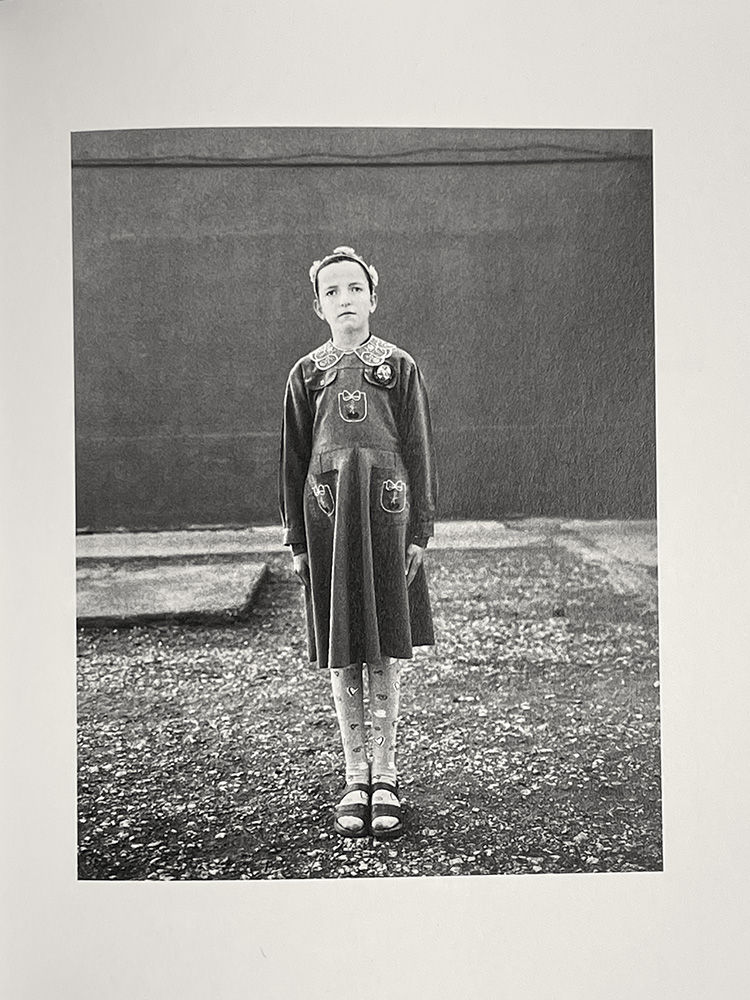


Vanessa Winship, Sweet Nothings. Published by Images En Manœuvres Èditions, 2008


Comments